Advocacy, learning and the pathway gap for young Africans
We asked 482 young people across six countries what they know about advocacy, what keeps them up at night, and what would make them act. Their answers reframe the problem, and should change where the rest of us focus our time, attention and money.
There is a comfortable story told about young Africans and civic life. That they are disengaged. That they need to be awakened. That the work is persuasion.
The data says something else entirely.
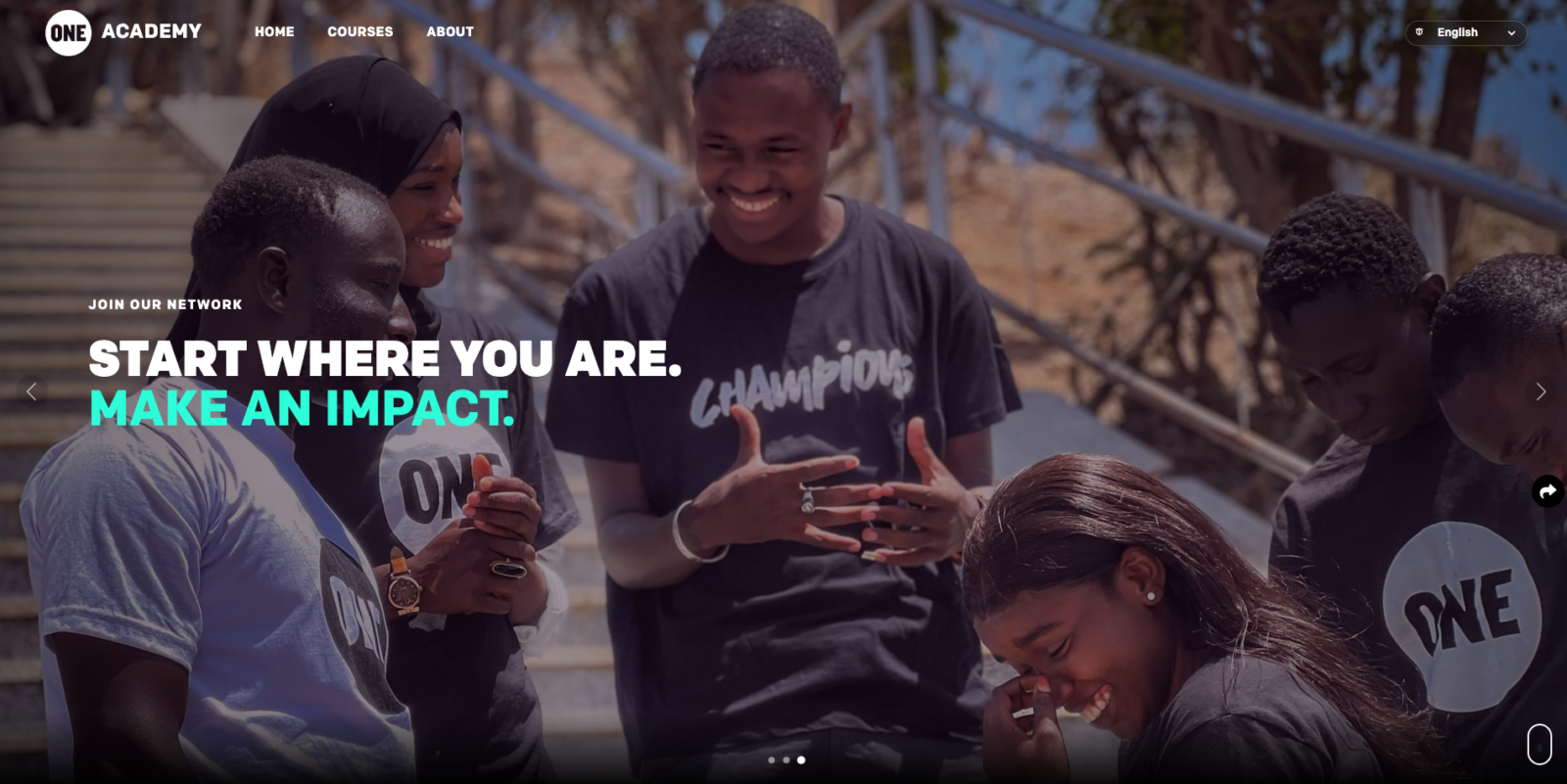
Between March and June 2026, ONE surveyed 482 young people aged 14 to 35 across Senegal, Kenya, Togo, Ghana, Tanzania and Zambia. We asked what advocacy means to them, which issues they carry, how they already learn, and what would bring them back. Their answers became the evidence base for ONE Academy, our flagship e-learning platform built to equip one million young Africans by 2030 with the knowledge, skills, credentials and pathways to influence policy and drive change.
The real headline is that this is not a motivation problem. It is an infrastructure problem, and infrastructure is buildable.
1. The distance between conviction and action is the whole story
Nearly 9 in 10 young people said they feel confident speaking up about issues they care about. 83% said they want to learn how to create change in their communities.
53% have ever actually participated in an advocacy activity.
Sit with that gap. It is not a gap in belief, appetite or courage. It is a gap in access to a first step, a credible entry point, a room, a mentor, or a campaign that will have them.
An entire generation is standing at the door with its hand raised, and almost half of them have never been let in.
2. They know what advocacy is. They are less sure what it looks like.
64% defined advocacy as speaking up to influence decisions, policies or systems. Solid.
But when we asked them to identify which real-world actions actually count as advocacy, they got an average of 2.5 out of 5 right, landing at 50.2%.
The pattern we discovered in their responses is the interesting part:
| Question Asked: Is This Advocacy? | %age of Youth Who Said Yes |
|---|---|
| Starting campaigns or organisations | 72% |
| Talking to friends about issues | 60% |
| Participating in community meetings | 48% |
| Writing to decision-makers | 40% |
| Sharing information and data | 30% |
Advocacy is very clearly recognised when it is loud and visible, but not nearly recognised when it is evidence-based, technical or aimed directly at the people who hold the pen.
Which means the most transferable, lowest-cost, highest-leverage advocacy skills on earth, like building a case, writing to power, putting a number in front of a minister, are the ones young people are least likely to know they already have permission to use.
That is not a deficit. That is an unopened toolbox.
3. The issues are economic before they are ideological
Asked what matters most, young people ranked unemployment first by a clear margin, followed by education, healthcare and youth exclusion from decision-making. Climate change and inequality ranked lower, not because they don’t matter, but because they compete with livelihood.
Young Africans engage with advocacy through what touches their lives on Tuesday. Not through abstract governance language.
Any curriculum, campaign or funding strategy that leads with the frame instead of the felt problem will lose this audience in the first thirty seconds. Any that starts with a job, a clinic, a classroom or a seat at the table will hold them.
4. There is a translation problem, and we found it in our own material
Education ranked as the second most important issue to these young people.
The proposed module on foundational learning reform ranked fifth out of seven, at 46% interest.
Same subject. Very different reception. The issue was not relevance; it was language. “Foundational learning” is sector vocabulary. It does not sound like the thing they said they cared about, even though it is exactly the thing they said they cared about.
This is one of the most useful findings in the report, and it generalises well beyond us. If your programme is underperforming with young people, check your framing before you check your thesis.
5. They are already learning, but just not where institutions are teaching
Young people reported using online learning platforms multiple times a week (4.2 on a 5-point scale), with the largest share learning daily.
Where:
- YouTube — 69%
- TikTok — 58%
- WhatsApp — 57%
- ChatGPT and similar AI tools — 57%
- Instagram — 37%
More than half of the young people we surveyed are already using AI tools to learn. Nobody trained them. Nobody funded it. They found it and adopted it faster than most institutions have finished writing their AI policy.
And when asked what else they wanted on the platform, some raised a module on using AI and tech to drive change.
The demand signal here is unambiguous. Young Africans are not waiting for permission to be digitally fluent. The question is whether our institutions can catch up to where they are already standing.
On format, they were just as clear: short videos (61.2%) and stories from real people (52.9%) lead, with quizzes (38.6%) and games or challenges (35.5%) close behind. Concise, human, applied.
6. They aren’t asking to be paid. They are asking to be taken seriously
This is the finding we did not expect, and the one funders should read twice.
The top motivators for returning to ONE Academy were certificates, leadership opportunities, peer networks and the platform being free.
Mobile data stipends ranked near the bottom. Gamification ranked lower than certification.
Meanwhile, 61% named internet connectivity as their single biggest barrier to online learning, and 19.9% named a lack of relevant content.
Read those together and the message is sharp: young people know connectivity is a real constraint, and they still would rather have something worth logging in for than be paid to log in. They are not asking to be incentivised. They are asking for recognition, for a network, and for the thing they earn to mean something in a room they haven’t entered yet.
Points and badges are not a strategy. Credentials, community and consequence are.
What this means, depending on where you sit
If you fund youth programming: The persuasion budget can be redirected. You are not buying awareness, because awareness is already there, at 83%. You are buying conversion: pathways, mentorship, credentials, first opportunities. That is a different line item and a much better return.
If you sit in government: There are millions of young citizens who understand what policy influence means and have never been given a legitimate channel to exercise it. Civic energy without a channel does not evaporate. It finds another outlet. Youth councils, consultation mechanisms and open policy processes are not goodwill gestures; they are pressure management and they are talent pipelines.
If you are a partner, platform or educator: Your competition is not another course. It is YouTube at 69% and TikTok at 58%. Meet young people on mobile, in short form, with real stories and real practice, or you will not be found at all.
If you are young and reading this: You already scored higher on conviction than most institutions score on delivery. What the data says you are missing is not talent or nerve. It is a structured first step. That is precisely what we are building through ONE Academy.
The real scoop is in the report
This baseline does two things. It gives ONE Academy an evidence base for curriculum, platform and engagement design. And it sets the line against which we will measure ourselves publicly, as learner outcomes and programme impact come in over the years ahead.
The full report goes considerably deeper than this summary: full methodology and limitations, module-by-module interest rankings, platform and format preferences, the complete retention picture, and the design implications we have drawn from each.
If you are designing anything for young Africans right now, be it a curriculum, a campaign, a grant window, or a policy consultation, this is a short read that will change at least one assumption you are currently working from.
So, what are you waiting for? If you have not hit the download button yet, here’s one more chance to.
Learn more about ONE Academy and follow its development at www.oneacademy.org
Lesijolu Eric-Nwabuzor leads Communications and Influence for Africa at The ONE Campaign (ONE). Alongside colleagues, her work engages policymakers, investors, media and the public to reframe how Africa is perceived, understood and valued.