The Issues
Survey Finds Rising Support for Global Disease Funding in 2026
A recent ONE survey of more than 8,000 US adults finds that large majorities of Americans — including voters who supported President Trump in 2024 — support US funding to fight infectious diseases overseas, including investments in childhood vaccines and HIV/AIDS treatment programs. Public support for global health funding has increased significantly since last year. Those gains were remarkably broad-based, spanning both parties and all demographics.
By a more than 7-to-1 margin, Americans believe the US government should invest in preventing and treating diseases in other countries to reduce the risk of future outbreaks reaching the United States. 72% support US global disease prevention funding, compared to just 9% who oppose it. Nineteen percent remain neutral or unsure. Support has increased 7% since ONE’s last poll in June 2025, when 65% of respondents expressed support for disease prevention funding abroad.
Bipartisan support for global health funding remains strong: 65% of self-identified Trump voters support US funding to combat disease overseas with 13% opposed, while 86% of Democratic voters support global health investments with only 3% opposed.
Even Stronger Support for HIV/AIDS Treatment
Seventy-nine percent of Americans support US funding for global HIV/AIDS treatment programs, compared to just 12% who oppose it. Support has increased by 10 percentage points since last year.
Strong majority support exists on both sides of the aisle: 72% of Trump voters and 91% of Democratic voters support US investment in HIV/AIDS treatment abroad, underscoring broad public support for continued US leadership in global HIV/AIDS and public health efforts.
Support for Childhood Vaccine Funding Notwithstanding Vaccine Hesitancy
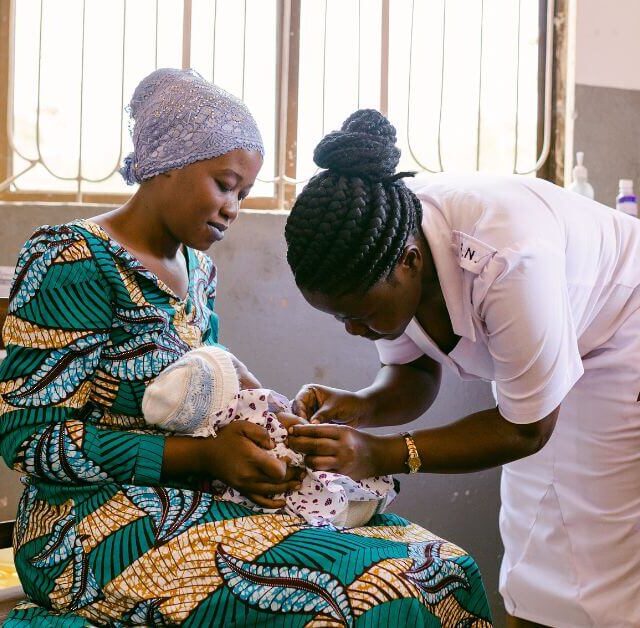
Americans support US funding for childhood vaccination programs in low-income countries by a 7-to-1 margin: 70% favor global vaccine funding, compared to just 10% opposed and 14% neutral or unsure. Support spans party lines, with 63% of Republicans and 85% of Democrats backing US investment in global childhood immunization programs.
Notably, this strong public support for global childhood vaccines persists even as 55% of Americans express some level of personal vaccine hesitancy. Polling data show that personal vaccine views do not directly translate into opposition to US global vaccine funding. Many Americans who report hesitancy about receiving vaccines themselves still support funding childhood immunization programs in low-income countries, indicating they view global health funding and personal vaccine decisions as distinct issues.
Notable Growth in Public Support
Between ONE’s 2025 and 2026 polls, American public support for US global health funding increased significantly across the board. Support grew for both global disease prevention investment and US HIV/AIDS treatment funding, with gains spanning political parties, regions, and demographic groups.
While the polling does not assign specific causes, the rise in support for global health investments may reflect increased public debate about foreign assistance, continued concerns about infectious disease threats, and growing awareness of the risks tied to cutting effective global health programs. The data show that public opinion on global health funding is not only strong but trending upward and remains one of the rare issues with broad bipartisan support among Americans.
Poll results, including with demographic and geographic breakdowns, can be downloaded below.
The findings presented here and linked above are the result of a ONE-commissioned poll of 8,040 US adults by Stack Data Strategy, with geographical estimates produced using multilevel regression and post-stratification (MRP).