Living in Belgium has made me realize how often Ghana is reduced to a simple story: peace, hospitality, music, and good food; as though these alone define the country. While those things are true, Ghana means much more to me than the image people often see from outside.
What troubles me about this incomplete image is that it reduces Ghana, and sometimes African countries more broadly, to comforting stereotypes that overlook political complexity, intellectual life, historical consciousness, and the everyday realities that we navigate. Even positive stereotypes can flatten societies into something one-dimensional. Ghana, to me, is not simply a “friendly African country.” It is a place shaped by history, rich culture, resilience, dignity, political consciousness, and an ongoing struggle to define its future on its own terms.
Ghana was the first sub-Saharan African country to gain independence from colonial rule in 1957 under the leadership of Kwame Nkrumah, first Prime Minister and President of Ghana. That moment did not only transform us as a country; it inspired liberation movements across the African continent and strengthened the broader vision of Pan-Africanism. Even today, that history continues to shape Ghana’s national identity. For us as Ghanaians, Pan-Africanism reflects a belief in African dignity, unity, self-determination, and the spirit of Ubuntu across the African continent.
But Ghana’s identity is not only shaped through politics and history. It is also carried through everyday life and memory. To me, Ghana is memory. It is the sound of market women calling out prices in the early morning, the exuberance of crowded streets, and the strong sense of community where neighbors are rarely strangers. It is a society where resilience is woven into everyday life and where people continue to support one another despite economic pressures and uncertainties. Yet when these qualities are presented only as signs of warmth, happiness, or simplicity, they can become misleading. They risk reducing Ghanaian society to emotional imagery while overlooking the political awareness, social debates about inadequate healthcare, inequalities, ambitions, and structural challenges that also shape our everyday lives. These ordinary moments are important, but they should not replace a comprehensive understanding of Ghana as a complex and dynamic society. Despite these challenges, Ghanaians continue to move forward with the spirit of Aluta continua, the struggle continues.
These experiences have also made me more aware of how Ghana continues to be perceived from the outside. Living between Ghana and Belgium has taught me that identity is never as simple as geography. There are moments when I miss Ghana in very ordinary ways: the humor, the spontaneous conversations, and the way people still make time for one another despite the daily hustle. I especially notice this during moments of difficulty or uncertainty here in Belgium. In Ghana, it is common for neighbors to check in on one another without invitation, for extended family members to contribute collectively when someone is struggling financially, or for entire communities to mobilize around funerals, illnesses, and celebrations. Distance has made me appreciate Ghanaian culture in deeper ways, not only through traditions, food, or music, but also through values of solidarity, hospitality, perseverance, and collective responsibility. These are values many of us in the diaspora continue to carry with us abroad.
At the same time, many people in Europe still misunderstand Ghana as simply a “poor but happy” country. While historical inequalities and colonial legacies continue to shape its economic position, this stereotype ignores Ghana’s deeper strengths: solidarity, resilience, and strong community values. It also overlooks the fact that Ghanaians are politically active, globally connected, and engaged in debates on inequality, healthcare, education, migration, and democracy. Ghana has enormous human and natural potential, supported by a highly skilled diaspora increasingly returning home to invest and contribute to the country’s development. This political and historical consciousness is also reflected in the role Ghana continues to play internationally.
While championing Pan-African and global voices, Ghana recently played a noteworthy role at the United Nations by supporting the adoption of a resolution recognizing the trafficking of enslaved Africans and racialized chattel enslavement as the gravest crimes against humanity. This recognition is important because it acknowledges not only the historical injustice itself, but also the lasting social, political, and economic consequences that continue to shape societies today. This too is part of Ghana’s identity: political engagement with global questions of justice and historical accountability.
What do I and many other Ghanaians ask from EU decision-makers? Simply to move beyond an aid-centered approach when engaging with Ghana and African countries. Young Ghanaians are not asking for charity or humanitarian sympathy. We are seeking fair economic partnerships, investment in education and healthcare, mobility opportunities, and policies that recognize Ghana and Africa as a continent more broadly, as facing crises, but also as a source of real and meaningful partnerships, ideas, leadership, innovation, and solutions.
In many international conversations, countries are often evaluated primarily through economic indicators such as Gross Domestic Product (GDP), development rankings, or investment potential. While these measures matter, they do not fully capture the humanity of a society or the values that hold communities together. My beloved country, Ghana, has taught me that dignity is also reflected in how people support one another during difficult moments, how our communities continue to preserve humanity despite hardship, and how collective memory and solidarity remain central to our everyday lives. Carrying these values with me while living in Belgium is something I remain deeply proud of as a Ghanaian–Belgian, because they remind me that Ghana has always been far more than the simplistic image often projected onto it.
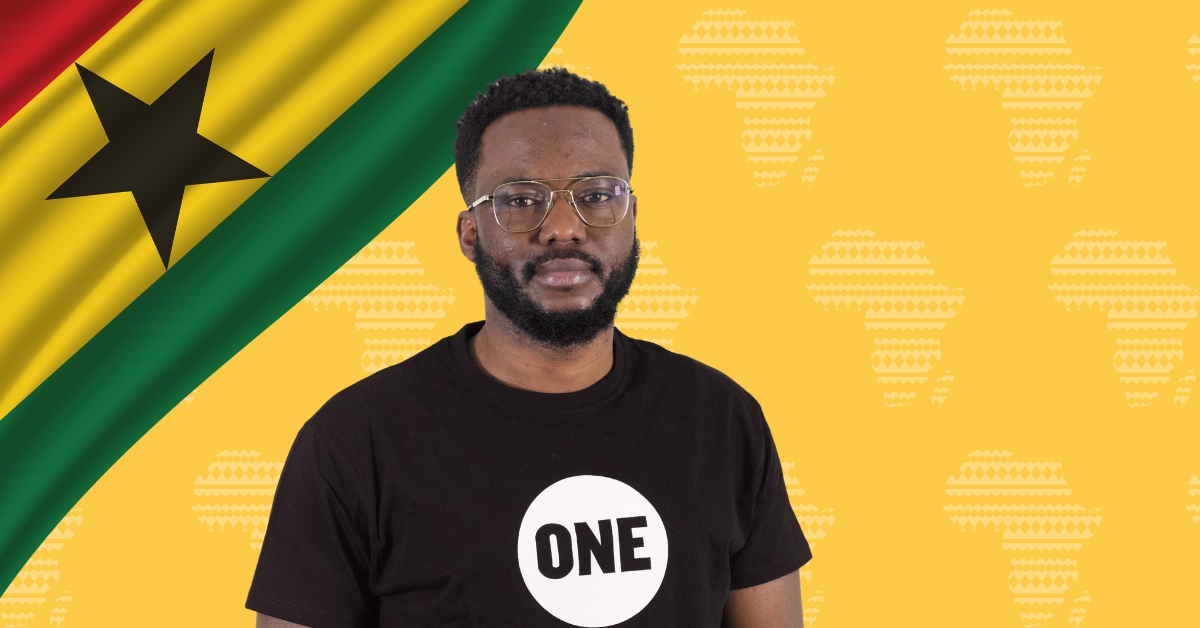
Jamari Jika is a ONE Youth Ambassador with Bachelor’s degree in Social Science from Vrije Universiteit Brussel (VUB) and a Master’s degree in Conflict and Development Studies from Ghent University (UGent).