Every year on May 25, Africa Day commemorates the founding of the African Union, formerly known as the Organisation of African Unity. It is a moment to celebrate African leadership, culture, and advocacy, and to reflect on the continent’s global contribution. But beyond celebration, it is also a call to action, to challenge the narrow and one-sided narratives that still shape how too many Europeans understand Africa, and to build in their place a partnership rooted in equality, solidarity, and shared progress.
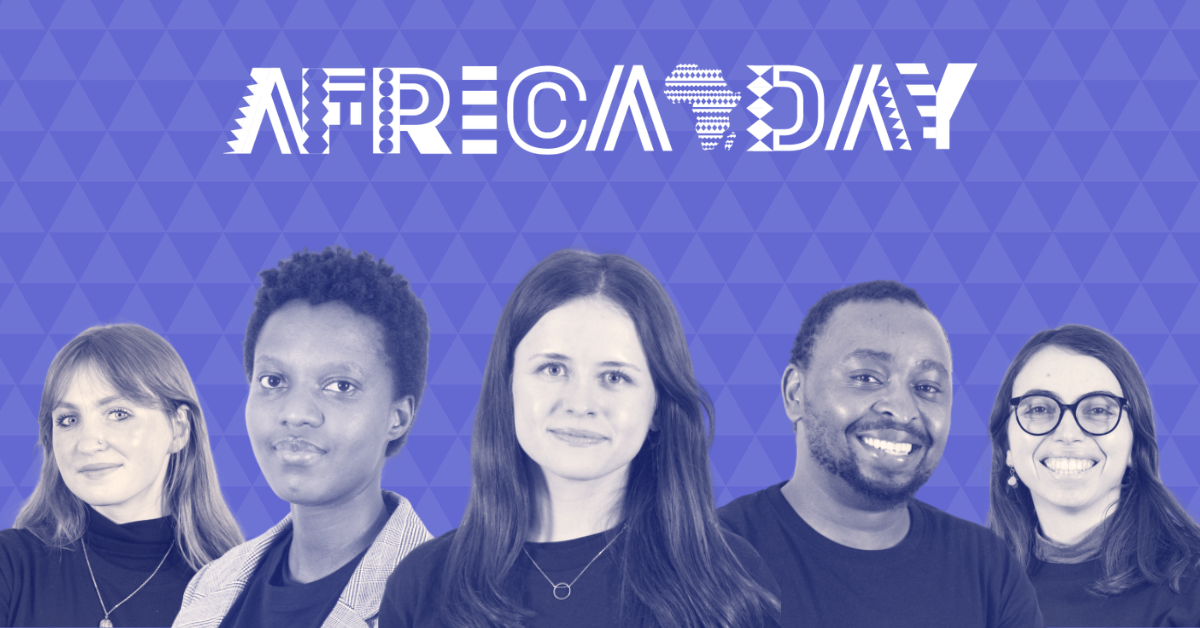
This year, five ONE Youth Ambassadors share why Africa’s future matters to them personally, and why it should matter to Europe at a time when the European Union is negotiating its next long-term budget and the future of the Global Europe Instrument.
An Alliance of Equals
Working in advocacy for the Middle East and Northern Africa (MENA) region at the European Parliament level, I have learned that the language institutions use reveals the relationships they imagine. Historically, the framework around the EU-Africa partnership has circulated around goodwill and charity, focusing on what Europe gives, and how many funds and programmes it delivers.
We can see that this approach is not sustainable for either side, and it is time to reframe that narrative.
Africa is the world’s youngest continent by population, with dynamic civic movements, growing economies, and some of the oldest civilizations humanity has known.
If Europe is serious about its future and its place in global politics, it needs partners, partners as strong and promising as the African continent.
But that partnership must be equal, dignified, and genuinely acknowledged, so that both continents can face shared challenges and grow stronger together, each filling the gaps where the other falls short.
Marianna Sokolowska Ciszewska is a ONE Youth Ambassador from Poland advocating for the MENA region.
What I Learned Listening to Young People in Burundi
As a Burundian woman who has worked with youth organizations, I spent years listening to young people described as “Africa’s future” while feeling largely excluded from shaping that future themselves. They had ideas, energy, and ambition, but lacked the opportunities and support to turn them into reality.
I met students with business ideas, young farmers adapting to climate change, and local activists trying to improve their communities with almost no resources. The problem was never a lack of motivation. It was a lack of opportunity.
Yet too many conversations in Europe continue to frame Africa mainly around migration, poverty, instability, and insecurity. That view misses a deeper reality: Africa’s future and Europe’s future are closely connected.
When young people are given real opportunities, they become entrepreneurs, innovators, and partners who contribute to stability and growth far beyond Africa.
Young Africans are not asking for charity. They want a fair chance to participate in shaping the future. Europe’s long-term stability depends on recognizing that potential, not ignoring it.
Jenny Elsie Arakaza is a ONE Youth Ambassador from Burundi advocating for economic justice.
The Decarbonization Divide
As a Kenyan student in sustainable development, I hear constant praise for Europe’s green transition. But from where I stand, this transition is creating a brutal “decarbonization divide.”
The reality is that Europe’s clean energy is subsidized by African sacrifices.
In the DRC, young people trade their health and education in toxic mines to extract the cobalt powering global electric vehicles. In Kenya, our lands are cordoned off for carbon credit projects so historic polluters can offset their guilt without actually cutting emissions.
We have become a continent of endless climate summits, yet the structural injustices remain completely untouched.
A genuine Europe-Africa partnership in 2026 cannot mean Europe gets the clean air while Africa gets the extraction and the offsets.
We do not need a redefined version of aid; we need a green transition that stops demanding the sacrifice of our youth and our soil.
Richard Ngugi is a ONE Youth Ambassador from Kenya advocating for equitable climate policy and human development.
Distance Costs Lives
My path into health economics began with understanding why some people live longer and healthier than others. The answer had little to do with medicine, but rather with how we relate to one another and with whose lives we consider worth protecting.
When African lives are perceived as distant, funding goes elsewhere, vaccines don’t arrive, and diseases that could be addressed are left to spread.
But distance in health is an illusion we pay for collectively, and COVID made that hard to deny, as variants born in under-vaccinated and overlooked populations travelled to the countries that had overlooked them.
It is not beyond us to build something different. When we genuinely commit to seeing every life as carrying the same weight, the answer becomes obviously simple: people live longer when we choose collaboration over distance, pool resources, and build across the borders we have drawn between us rather than retreat behind them.
Mirela Curmei is a ONE Youth Ambassador from Moldova advocating for equitable health policies.
The Village That Showed Europe What Integration Can Do
Riace is a small village in Calabria (Italy) today celebrated as a successful model of migrant integration. Once near abandoned due to emigration, it was reborn through the welcome of migrants, becoming known as the Global Village.
In 1998, when around 200 refugees shipwrecked nearby, Mimmo Lucano, later mayor and now an MEP, offered them the village’s empty homes through the association Città Futura. As mayor, he channelled government funds into cooperatives employing migrants in local crafts and businesses. Schools reopened, homes were renovated, and the local economy revived.
Migrants found dignity and integration, while locals could finally choose to stay.
Riace remains concrete proof that Europe’s relationship with Africa cannot be reduced to border control or conditional partnerships built around stopping migration at all costs. Migration will happen.
The real question is whether Europe chooses to treat it only as a threat to contain, or also as a reality that, when managed with dignity and inclusion, can bring real economic and social benefits, and may revive the many abandoned villages of southern Europe left behind.
Costanza Panti is a ONE Youth Ambassador from Italy advocating for migration and integration.
Africa Day reminds us that the future of Africa is inseparable from the future of Europe and the world. As ONE Youth Ambassadors, we want to rewrite the story. Because we are already united in our challenges, whether climate, health, or opportunity, and we must become united in our solutions.