Almost two-thirds of Brits want government to maintain or increase funding to fight HIV/AIDS, TB and malaria
- New polling reveals overwhelming public support for continued UK investment in the Global Fund to Fight AIDS, Tuberculosis and Malaria, as ministers weigh up cuts
- Respondents also cited the UK’s role in fighting HIV/AIDS, TB and malaria around the world as the country’s third most significant achievement of the 21st century – behind only the Covid vaccine rollout and hosting the London 2012 Olympic Games
- The ONE Campaign urged the Foreign Secretary to show global leadership ahead of November’s key replenishment summit, where the Global Fund aims to raise £13.5 billion
- Germany recently announced a €1 billion (£870 million) pledge to the Global Fund – putting pressure on the UK, who will co-host the replenishment conference
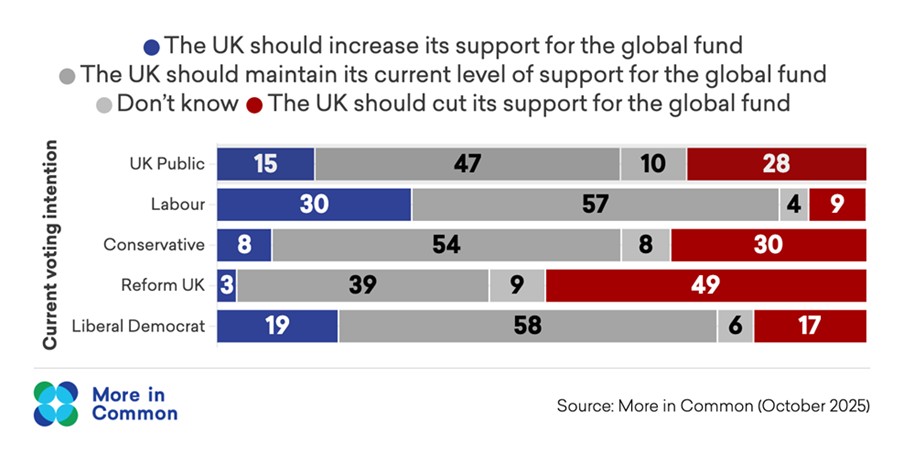
London, UK – 20 October 2025 – Almost two-thirds of Britons (62%) believe the UK Government should maintain or increase its financial support for the world’s leading partnership tackling HIV/AIDS, tuberculosis and malaria, according to new polling by More in Common for the ONE Campaign.
If Keir Starmer’s government matches the previous pledge of £1 billion to the Global Fund to Fight AIDS, Tuberculosis and Malaria – made by Rishi Sunak’s government in November 2022 – it will save an estimated 1.7 million lives globally between 2027 and 2029.*
The Global Fund is seeking to raise $18 billion (£13.5 billion) at its next replenishment summit in November – in its efforts to save 23 million lives in some of the world’s most disadvantaged countries.
Since its creation in 2002, the Fund has already saved 70 million lives and reduced the combined death rate from AIDS, TB and malaria by 63%.
It is understood the Foreign Secretary, Yvette Cooper, is considering a cut to the UK’s contribution, following February’s 40% reduction to the Official Development Assistance (ODA) budget. Every £100 million cut from the UK’s contribution would mean an estimated 170,000 fewer lives saved over the next three years.**
Germany recently announced a €1 billion (£870 million) commitment to the Global Fund, exceeding expectations and increasing pressure on the UK, which will co-host November’s replenishment conference in partnership with South Africa.
The More in Common polling also shows cross-party backing for continued investment:
- 87% of Labour, 62% of Conservative, and 77% of Liberal Democrat voters support maintaining or increasing the UK’s pledge.
- Even though 49% of would-be Reform UK voters favoured cuts to the Global Fund, another 42% want the government to protect or increase support
Respondents also cited the UK’s role in fighting HIV/AIDS, TB and malaria around the world as the country’s third most significant achievement of the 21st century – behind only the Covid vaccine rollout and the London 2012 Olympics.
Among Labour voters, it was considered Britain’s second-most important achievement, ranking higher than hosting the Olympics.
Adrian Lovett, UK Executive Director of The ONE Campaign, said:
“The UK has always been ready to play its part in the fight against deadly diseases. Working together in partnership, the world has seen dramatic progress which has made us all safer and more secure. A large majority of people from across the political spectrum now want the UK to maintain its commitment to fighting HIV/AIDS, TB and malaria.
“People see the UK’s role in tackling these terrible diseases as one of our most significant achievements of the 21st century. The message is clear: British people want their government to save lives, and protect us from the spread of diseases that do not stop at national borders.
“With Germany stepping up, all eyes are now on Britain. The UK has an opportunity to make a bold statement of its commitment to ending these deadly diseases – or risk hundreds of thousands of lives.”
-ENDS-
Notes to Editors
Polling was conducted by More in Common between 10–13 October 2025, based on a nationally representative sample of 2,004 GB adults.
Respondents were weighted by age, sex, ethnicity, region, education and 2024 General Election vote.
The Global Fund to Fight AIDS, Tuberculosis and Malaria has saved an estimated 70 million lives since its creation in 2002.
The ONE Campaign is a global, nonpartisan organisation advocating for the investments needed to create economic opportunities and healthier lives in Africa.
Methodology:
* The Global Fund has set a fundraising target of $18 billion (£13.5 million), which it says will help it to save 23 million lives in some of the world’s most disadvantaged countries between 2027 and 2029.
Therefore, a £1 billion commitment by the UK would account for 1.7 million lives saved.
** Every £100 million cut from the contribution will result in 170,000 fewer lives saved